Concrete Foundation Options for New Herriman Construction
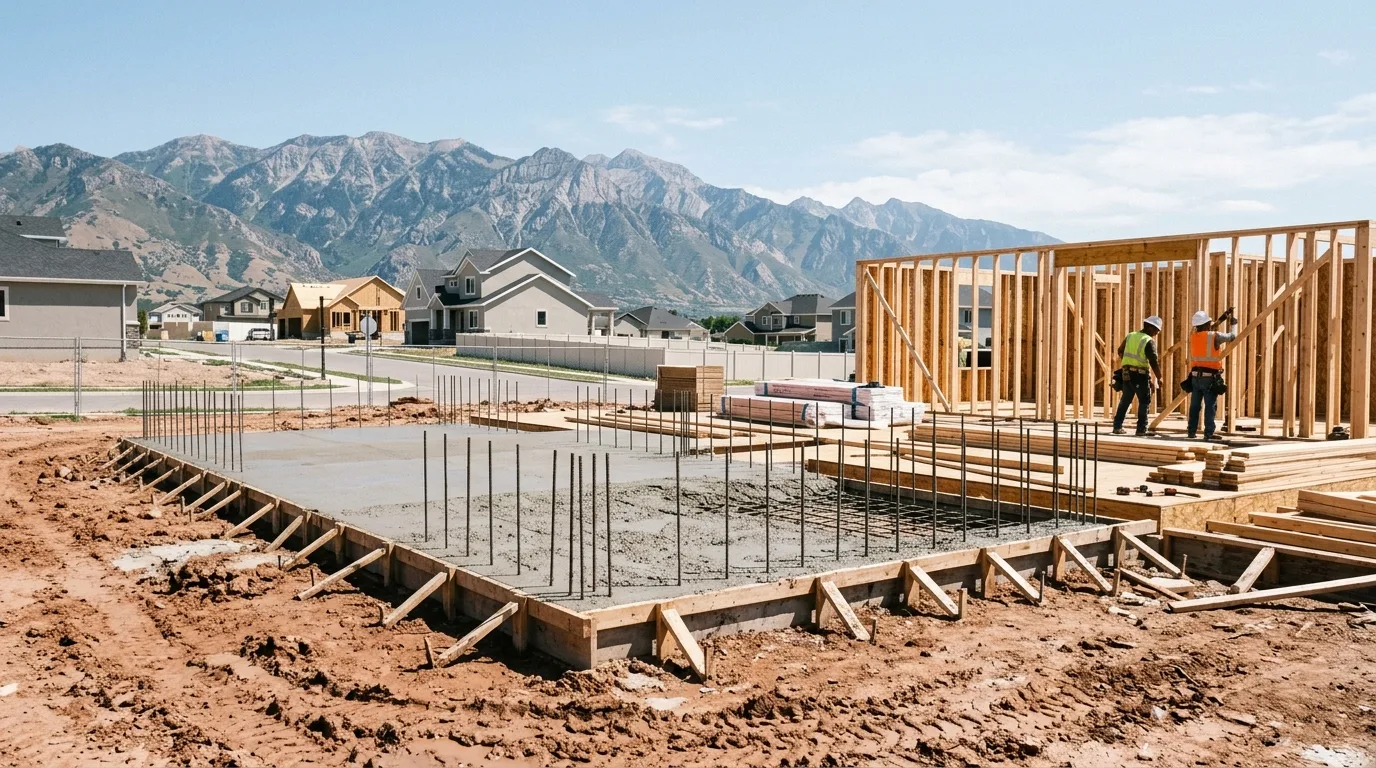
Herriman is one of Utah’s fastest-growing cities, and the Olympia development in northwest Herriman alone will add thousands of new homes over the coming decade. For homeowners building new or adding significant square footage, the foundation type decision has more long-term implications in Herriman than in most markets because of the city’s clay-heavy soils and freeze-thaw climate. This guide covers the three main concrete foundation types used in Herriman and when each makes sense.
Concrete Foundation Work in Herriman, UT
We install all foundation types with specifications engineered for Salt Lake County's soils. Free estimates.
Why Foundation Type Matters More in Herriman
In stable soil conditions, foundation type is mostly a cost and use-case decision. In Herriman’s Lake Bonneville clay soils, it’s also a risk management decision.
The expansive clay soils in Herriman’s Rosecrest, Blackridge, and Olympia areas shrink and swell with seasonal moisture changes — movement that exerts significant forces on concrete structures. Different foundation types respond to these forces differently, and the right choice depends on the magnitude of soil movement at your specific site, the load type being supported, and the climate control requirements of the structure.
A geotechnical soil report (soil test) is worthwhile for any significant new construction in Herriman. The report identifies clay content, bearing capacity, and active zone depth — all of which affect foundation type selection and engineering requirements.
Foundation Type 1: Slab-on-Grade
What it is: A single concrete pour — typically 4–6 inches thick — that forms both the floor and the foundation. The perimeter is thickened to 12–18 inches to form integral footings below the frost line.
When it’s used in Herriman: Garages, outbuildings, workshop additions, ADUs, and some single-story home additions. It’s the most common foundation type for accessory structures throughout Salt Lake County.
Advantages:
- Most cost-effective foundation type
- No crawl space maintenance required
- Fast installation (typically 3–5 days for modest-sized structures)
- Strong performance on stable soils with proper gravel base
Disadvantages:
- Provides no access to plumbing and mechanical systems from below
- More vulnerable to soil movement than perimeter foundations in high-clay soil areas
- Not appropriate for basement construction
Herriman-specific requirements:
- Compacted gravel base: 4–6 inches minimum to buffer clay soil movement
- Vapor barrier under slab to prevent moisture migration
- Perimeter thickening must extend below Herriman’s frost line (30–36 inches minimum)
- Rebar throughout the slab per engineering schedule
Cost in Salt Lake County: $8–$15 per square foot for residential accessory structures.
Slab-on-Grade Foundation for Your Herriman Garage or Addition
We engineer slab foundations for Herriman's clay soils. Free estimates — call today.
Foundation Type 2: Perimeter Foundation with Crawl Space
What it is: Concrete footings at the base of concrete stem walls that form the perimeter of the structure. The floor is suspended above a crawl space rather than resting on grade.
When it’s used in Herriman: Full home additions, structures with mechanical systems requiring below-floor access, and cases where soil conditions make slab-on-grade less desirable.
Advantages:
- Provides access to plumbing, HVAC, and electrical systems from below
- Isolates the floor from direct soil contact, providing better protection against soil movement in high-clay-content areas
- Can be constructed on sloped sites where slab-on-grade would require extensive fill
- Allows floor insulation for conditioned spaces
Disadvantages:
- More expensive than slab-on-grade for equivalent footprint
- Crawl space requires moisture management (vapor barriers, ventilation) in Herriman’s seasonal moisture conditions
- Longer construction timeline
Herriman-specific requirements:
- Footings must reach below the frost line (30–36 inches) and into stable soil below the active zone
- Crawl space ventilation or encapsulation to manage moisture in Utah’s climate
- Drainage at footing level to prevent water accumulation during spring thaw
- More aggressive rebar schedule for stem walls due to lateral soil pressure from Herriman’s clay soils
Cost in Salt Lake County: $15,000–$40,000+ for full perimeter systems depending on structure size and soil conditions.
Foundation Type 3: Full Basement Foundation
What it is: Concrete footings and perimeter walls that extend 8–10 feet below grade, creating a full usable below-grade space.
When it’s used in Herriman: New home construction where the home is designed with a finished basement. Common in Herriman’s higher-end developments where the finished basement square footage significantly increases home value.
Advantages:
- Maximizes usable space — a finished basement adds square footage at much lower cost-per-foot than above-grade construction
- Excellent access to mechanical systems
- In Herriman, the stable temperature below grade reduces HVAC loads
Disadvantages:
- Highest cost foundation type
- Complex waterproofing requirements due to Herriman’s seasonal water table
- Requires careful drainage engineering on hillside lots (Blackridge, Juniper Crest)
- Expansive clay soils require drainage mat and waterproofing on the exterior of basement walls
Herriman-specific requirements:
- Exterior waterproofing membrane on all below-grade walls (clay soils hold moisture against walls)
- Drainage mat or dimple board between the waterproofing and backfill
- French drain system at footing level
- Interior sump pump system as secondary protection
- Wall reinforcement for lateral soil pressure from expansive clay backfill
Cost in Salt Lake County: Full basement foundation cost is typically included in new home construction bids; additions with basement are highly site-specific.
Making the Right Choice for Your Herriman Project
For most accessory structures — garages, sheds, workshops — slab-on-grade with proper gravel base and rebar is the right choice in Herriman when the soil bearing capacity at your site is adequate.
For structures requiring plumbing access or facing challenging soil conditions, a perimeter crawl space foundation provides better long-term performance and access.
For full home construction in Herriman’s hillside areas or on lots with particularly active clay soils, a structural engineer’s input on foundation type is worthwhile before the contractor is hired.
Frequently Asked Questions
Do all concrete foundations in Herriman require permits?
Yes — all foundation types require building permits from the Herriman City Building Department. Footing inspections are mandatory before any concrete is poured — this inspection cannot be skipped. Your contractor must hold a current Utah DOPL license. Contact the Herriman Building Department at 801-446-5327 for specific permit requirements for your project type.
How deep do footings need to be in Herriman, UT?
Herriman footings must extend at least 30–36 inches below grade to clear the frost line. In areas with soft or expansive clay at shallow depth, footings may need to go deeper to reach stable bearing soil. The geotechnical engineer or the Building Department inspector verifies adequate footing depth before the pour is authorized.
Can I add a foundation to an existing structure in Herriman?
Yes — foundation additions for room additions, garage expansions, and ADUs are common in Herriman. These projects follow the same permit and inspection process as new construction. The junction between new and existing foundations requires careful engineering to prevent differential settlement.
New Construction Concrete Foundations in Herriman
Call (888) 376-0955 — we engineer foundations for Herriman's clay soils and freeze-thaw climate.
Related: