Why Utah's Clay Soil Matters for Your Concrete Foundation
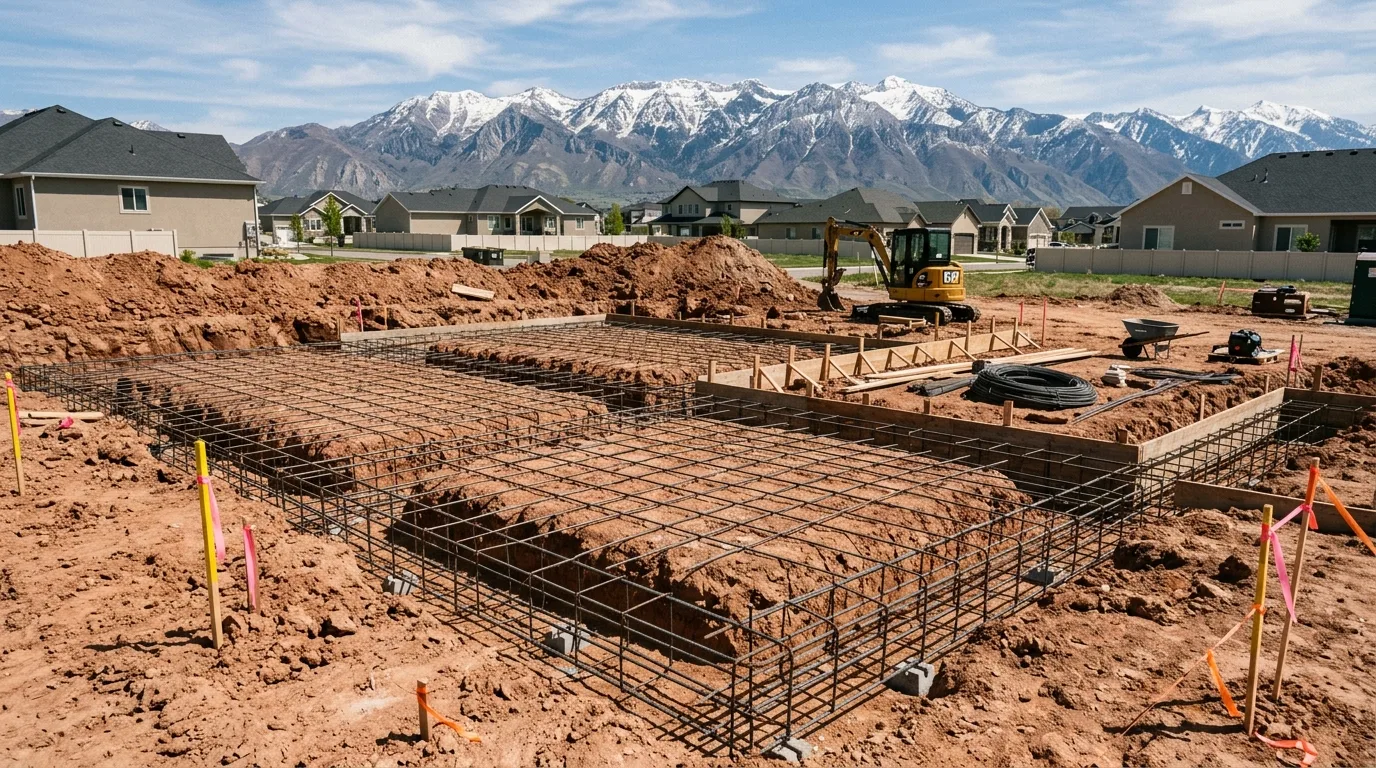
When geotechnical engineers survey lots in Herriman for new construction, they consistently find the same thing beneath the topsoil: clay-heavy sediment deposited by ancient Lake Bonneville, the prehistoric inland sea that covered most of the Salt Lake Valley roughly 14,000 years ago. These deposits are not a curiosity — they’re a primary engineering constraint that determines how concrete foundations in this area must be designed, how deep footings must reach, and why shortcuts that work in other soil conditions fail systematically in Salt Lake County.
Need Foundation Work in Herriman?
We design concrete foundations specifically for Herriman's soil conditions — not generic specs.
What Makes Herriman’s Soils Different
Lake Bonneville covered roughly 20,000 square miles at its maximum extent. As it receded, it left behind fine-grained clay and silt deposits throughout the Salt Lake Valley. These sediments have two properties that matter enormously for concrete construction:
Expansive behavior. Clay particles absorb water and expand — sometimes significantly. In Herriman’s Rosecrest and Blackridge neighborhoods, soils can increase in volume by 5–10% or more when saturated by spring snowmelt. When they dry out again in late summer, they contract back. This seasonal cycle can produce vertical movement of several inches in the active soil zone near the surface.
Poor bearing capacity when saturated. Wet clay is soft and compressible. Under the point loads of structural footings, saturated clay can compress unevenly, causing differential settlement that cracks concrete structures. This is why footing inspections in Herriman verify not just depth but soil condition at the bearing depth.
How Clay Soils Damage Concrete Foundations
The mechanism is consistent across the Oquirrh Mountain foothills area: water enters the soil near the foundation perimeter during spring thaw and heavy rain events. The clay soils expand upward — pushing against the underside of concrete slabs and sideways against foundation walls. When the soil dries, it shrinks away from the concrete — leaving voids beneath slabs and releasing the lateral pressure on walls.
Over years, this cycle works concrete joints apart, opens cracks at corners where stress concentrates, and can cause slabs to rock or settle unevenly as the void pattern beneath them changes with each seasonal cycle. In the newer developments in the Olympia area of northwest Herriman, where construction is ongoing on soils that haven’t been compacted by decades of development, this process can be more pronounced than in established neighborhoods.
The secondary damage vector is water accumulation. Expansive clay soils have low permeability — water that pools near a foundation doesn’t drain away quickly, which prolongs the saturation period and extends the time the soil is applying expansion pressure on the foundation. Proper drainage around the foundation perimeter is therefore a structural protection measure, not just an aesthetic one.
Foundation Concrete in Herriman — Built for Utah Soils
We specify foundations that account for Herriman's clay conditions. Free estimates.
What Proper Foundation Engineering Looks Like in Herriman
Footing depth. In Herriman, footings must reach below both the frost line (at least 30–36 inches below grade) and the active clay zone. The frost line requirement is the typical engineering driver, but in areas with particularly active soils, deeper footings may be required to reach stable bearing material.
Rebar schedule. Concrete foundations in Herriman typically require more rebar than minimum code because the soil movement creates bending and uplift forces that require tensile reinforcement to resist. A standard residential footing in many warmer states uses #4 rebar at 18-inch spacing; Herriman conditions often warrant #5 bars at 12-inch spacing for footings that will experience significant lateral soil pressure.
Compacted gravel under slabs. Slab-on-grade foundations — common for garages and additions throughout Salt Lake County — require 4–6 inches of compacted crushed gravel between the native clay soil and the concrete slab. This gravel layer serves as a capillary break that prevents moisture from wicking up through the slab, and as a stable, non-compressible base that buffers soil movement.
Perimeter drainage. Foundation drains at footing level, or positive drainage grading away from the structure, prevent water accumulation that drives soil expansion. This is particularly important in Juniper Crest and Blackridge, where hillside topography can concentrate drainage against uphill foundation walls.
Vapor barriers. Under slab vapor barriers prevent moisture migration from the clay sub-grade into the concrete slab, reducing moisture-related slab damage and protecting the interior environment of the structure.
What Happens When These Measures Are Skipped
The consequences of skipping proper foundation engineering in Herriman’s soils are predictable and well-documented in the local construction history:
Slabs installed on clay without gravel bases develop cracks and rock within 5–10 years as the soil beneath them moves. Foundation walls without adequate drainage crack from lateral soil pressure during spring thaw. Footings that don’t reach below the frost line experience frost heave that tilts and cracks the structures above them.
Across the Salt Lake Valley, the repair cost for foundation problems caused by inadequate initial engineering significantly exceeds the cost of proper engineering upfront. For homeowners planning additions, outbuildings, or other concrete foundation work in Herriman, the right time to invest in proper engineering is before the pour.
Frequently Asked Questions
How deep should footings be for a garage addition in Herriman?
At minimum, footings in Herriman must reach 30–36 inches below grade to clear the frost line. In areas with soft or expansive clay near the surface, footings may need to go deeper to reach stable bearing soil. The required depth is verified by the Herriman City Building Inspector during the mandatory pre-pour footing inspection. Do not backfill around forms until this inspection is complete.
Should I get a soil test before pouring a foundation in Herriman?
For large projects — full home additions, basement expansions, multi-car garages — a geotechnical soil report is worthwhile and may be required by the building department. For smaller footings (sheds, small additions), an experienced local contractor familiar with Herriman’s soil conditions can typically assess the soil condition visually at the excavated footing depth. When in doubt, a few hundred dollars for a soil bearing test is cheap insurance against a foundation that settles unevenly.
What’s the difference between a slab-on-grade and a perimeter foundation?
A slab-on-grade is a single concrete pour that serves as both the floor and the foundation — common for garages and outbuildings. A perimeter foundation consists of footings and stem walls around the perimeter of the structure, with the floor poured separately or not at all (in the case of crawl spaces). For Herriman’s clay soils, both types require proper base preparation and drainage, but perimeter foundations allow the floor slab to be isolated from soil movement in ways that slab-on-grade cannot.
Build Your Foundation Right the First Time in Herriman
Call (888) 376-0955 for a foundation estimate engineered for Salt Lake County soils.
Related: